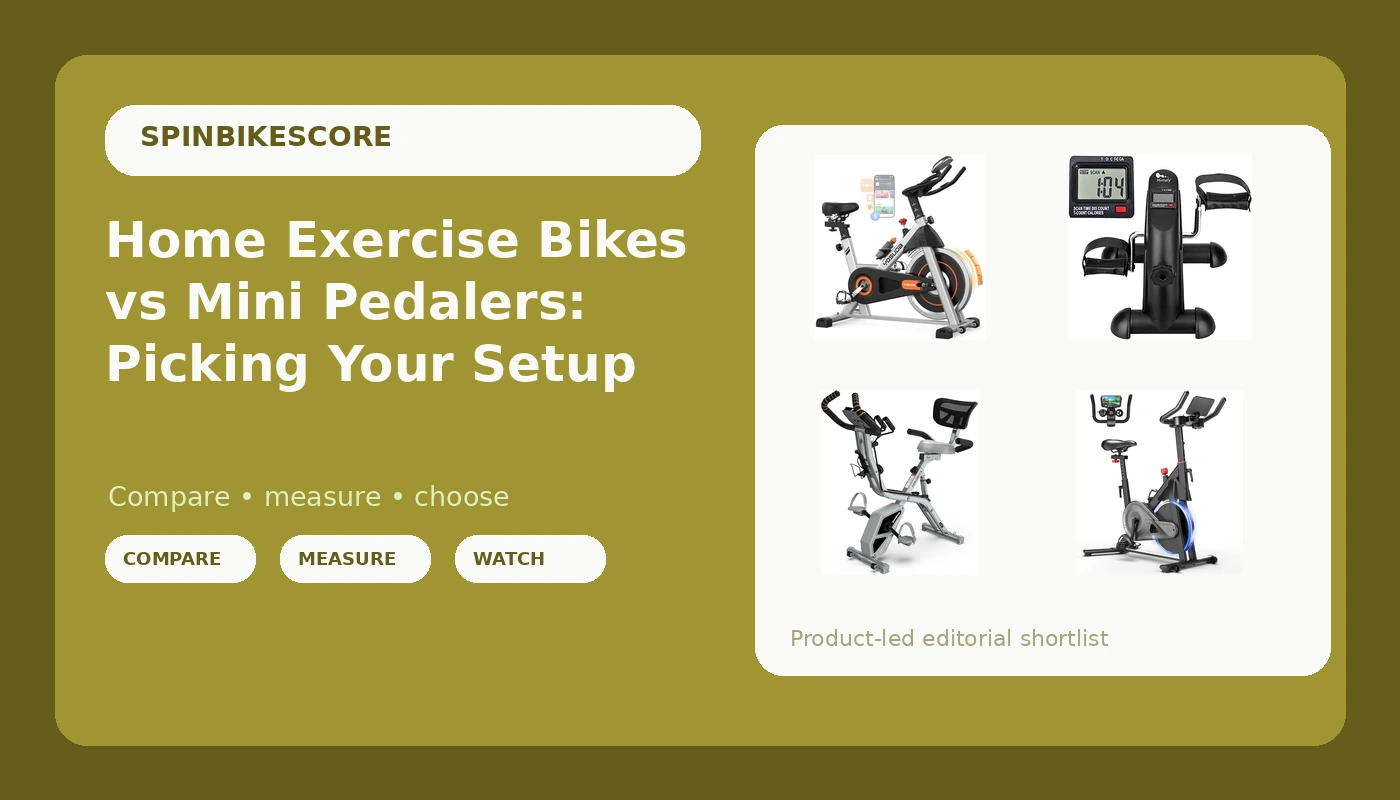
Buying home exercise bikes is really a space-and-fit problem dressed up as a spec problem. Most riders start by comparing flywheel weights and resistance levels, then discover the machine they ordered is too tall for the room, too wide for their hips, or dull enough that it becomes a clothes rack by February. The four options below cover the realistic spread of what people buy for home cardio: a full-size indoor cycling bike with 32 levels of magnetic resistance and an adjustable seat and handlebars, a magnetic friction bike with app training, a folding upright, and a compact mini pedal exerciser that turns almost any chair into a leg workout. None of them is a studio bike, and that is fine. What matters is which one survives contact with your actual routine.
Related: How to Set Up a Spin Bike for a Home Workout →
Quick answer
If you plan to stand out of the saddle and ride hard, start with a full-size indoor cycling bike that lists magnetic resistance plus an adjustable seat and adjustable handlebars. If your goal is extra leg movement while you work at a desk, or low-impact movement for arms and legs, a mini pedal exerciser is the right tool. If the bike has to disappear between rides, a folding upright makes more sense. If guided sessions are what keep you consistent, look for a bike that lists app training. Fit and floor space decide more than any single feature on the spec sheet.
4 useful options
| Model | Best fit | What stands out |
|---|---|---|
| Indoor Cycling Bike - 32-Level Magnetic Resistance Stationary Exercise Bike with Adjustable Seat & Handlebars, Silent Belt Drive for Home Cardio (Fits Users 5'1" to 5'11", 300lbs Capacity) | Riders who want a full-size bike for seated and standing efforts | 32 levels of magnetic resistance, adjustable seat and handlebars, stated fit range of 5'1" to 5'11" |
| YOSUDA Exercise Bike, Magnetic Friction Stationary Bike with App Training | Riders who want guided workouts from a phone or tablet | Magnetic friction resistance paired with app training |
| pooboo Folding Magnetic X-Bike, Upright Exercise Bike for Home Gym | Small spaces where the bike must be stored between rides | Folding frame with magnetic resistance in an upright format |
| Mini Exercise Bike, himaly Under Desk Bike Pedal Exerciser Portable Foot Cycle Arm & Leg Peddler Machine with LCD Screen Displays | Desk work, chair-based movement, and arm pedaling | Portable pedal exerciser for arms and legs with LCD screen displays |
Full-size indoor cycling bike: Indoor Cycling Bike - 32-Level Magnetic Resistance Stationary Exercise Bike with Adjustable Seat & Handlebars, Silent Belt Drive for Home Cardio (Fits Users 5'1" to 5'11", 300lbs Capacity)
This is the only option in the group built for standing work. Standing puts far more load on the frame and the stabilizer feet than seated pedaling does, which is why adjustability and resistance type matter here more than anywhere else. Magnetic resistance means nothing contacts the flywheel, so there is no pad to wear and the setting you used last month should still feel like the same setting. Thirty-two levels means small jumps between settings, which helps when you want to nudge effort up one notch in the middle of an interval rather than leap from easy to miserable. The stated fit range is the catch: riders above 5'11" should look elsewhere.
App-connected option: YOSUDA Exercise Bike, Magnetic Friction Stationary Bike with App Training
App training solves a specific problem: riders who quit because they run out of ideas after two weeks. A screen with someone telling you what to do next is worth more than another resistance level. The trade-off is maintenance. Friction-based resistance works by pressing a pad against the flywheel, and pads wear, glaze, and eventually need replacing. That is not a defect, it is the design, and it is why friction bikes often cost less than magnetic ones. If you ride most days, plan on replacing pads periodically and checking tension before sessions.
Folding upright: pooboo Folding Magnetic X-Bike, Upright Exercise Bike for Home Gym
Folding bikes trade something for that convenience, and it is usually frame stiffness. A hinge is a joint, and joints flex. That does not rule the bike out for seated, steady-state riding, but it is the reason a folding upright is a poor match for riders who want to stand and sprint. Set expectations accordingly: this is a bike for consistent, moderate sessions in a room that has to double as something else. Check the folded dimensions against your storage spot before buying, because folded size varies a lot between models.
Desk pedal exerciser: Mini Exercise Bike, himaly Under Desk Bike Pedal Exerciser Portable Foot Cycle Arm & Leg Peddler Machine with LCD Screen Displays
A mini pedaler is not a substitute for a spin bike, and treating it as one leads to disappointment. There is no flywheel to carry momentum, no saddle to sit on, and no way to stand up and grind. What it does well is remove the two biggest barriers to movement: setup time and space. It also works for arm pedaling, which matters for anyone rehabbing a shoulder or looking for upper-body movement while seated. If you want calorie-torching intervals, this is the wrong tool. If you want to stop sitting completely still for eight hours, it is a genuinely useful one.
Prices and availability may change. Product images, names, and retailer links must be matched by verified ASIN. Do not state a current price, rating, stock status, or measured result without current evidence.
Magnetic resistance versus friction pads
Magnetic resistance moves magnets closer to the spinning flywheel. Nothing touches, so there is no pad to wear down, no felt dust, and the resistance at a given setting should feel the same in month twelve as it did in week one. That repeatability is the underrated part. If you are running intervals and trying to hold the same effort week to week, a resistance system that drifts makes your training log meaningless.
Friction resistance is the older design. A pad presses against the flywheel, and the knob controls how hard it presses. It costs less to manufacture, and a well-built friction bike can feel smooth. The trade-offs are wear and noise. Pads glaze, flatten, and eventually need replacing, and the contact point can add a low rumble that belt-driven magnetic bikes avoid. If you ride most days, budget for a pad or two a year and check tension before sessions.
Flywheel weight gets marketed hard. It matters, but not the way the spec sheet implies. A heavier flywheel stores momentum and smooths the dead spots at the top and bottom of each pedal stroke. On a light flywheel, high-cadence work feels choppy. But weight only helps if the frame holds it steady. A heavy flywheel in a flexy frame is worse than a moderate flywheel in a stiff one, and that is why standing sprints are the real test of any home bike.
Drive type is a maintenance decision. Belt drives run quiet and need no lubrication. Chain drives are durable and serviceable but need occasional oil and make more noise. Neither is automatically better. They are different chores, and you should pick the chore you will actually do.
Finally, count the resistance levels. The full-size option here lists 32, which means small jumps between settings. That is useful when you want to nudge effort up by a notch mid-interval instead of leaping from easy to brutal. Fewer levels is not a dealbreaker, but it does change how precisely you can pace a session.
Fit and footprint: what to check before you buy
Fit comes before features. A bike that fits you badly will hurt your knees, your sit bones, or both, and no resistance system fixes that. Start with the height range the listing states. The full-size indoor cycling bike here is described as fitting riders from 5'1" to 5'11", which covers many adults but excludes taller riders. If you are outside a stated range, believe the range rather than the product photos.
Check adjustability in two places: the seat post and the handlebars. A seat that moves up and down but not forward and back limits how well you can set knee angle. Handlebars that only move vertically limit how much you can change torso angle when your lower back complains. Two riders sharing one bike need more adjustment range, not less, so count the riders before you count the features.
Then look at the saddle itself. On most budget bikes the seat is the first part people replace, so treat it as a wear item and factor a replacement into your plan. Pedals with plastic cages are the second common replacement.
Footprint is the other half of the decision. A full-size bike needs a semi-permanent home with enough clearance to stand beside it and mount from the side. A folding upright can be folded and moved aside between sessions, which matters in a small apartment. A mini pedal exerciser needs only floor space in front of a chair, which is why it works in offices and living rooms where a full bike would never fit. If you plan to stand and pedal, check ceiling height as well.
- Measure the floor space and ceiling height where the bike will live, and decide honestly whether it can stay out permanently.
- List everyone who will ride it, then compare their heights against the stated fit range on each listing.
- Decide whether you need standing efforts or seated pedaling only. Standing demands a stiffer frame and a stable base.
- Choose the resistance type you are willing to maintain: magnetic for nothing to replace, friction for a lower-cost mechanism that needs pads over time.
- Set a total budget that includes a replacement saddle, a floor mat, and anything else the first month of ownership tends to require.
Setting up whichever bike you choose
- Put a mat under the bike. Sweat is the most common cause of rust on budget frames.
- Re-torque the seat post, handlebar, and pedal bolts after the first few rides, then check them monthly.
- Keep pedals tight. A loose pedal can strip a crank arm, and crank arms are not cheap to replace.
- Set saddle height so your knee keeps a slight bend at the bottom of the pedal stroke, then adjust reach.
- If the bike wobbles, check floor level and the stabilizer feet before blaming the frame.
- Log your resistance settings for a few sessions so you can tell whether the mechanism is drifting.
Which option should you choose?
Choose the Indoor Cycling Bike - 32-Level Magnetic Resistance Stationary Exercise Bike with Adjustable Seat & Handlebars, Silent Belt Drive for Home Cardio (Fits Users 5'1" to 5'11", 300lbs Capacity) when you want a full-size bike for seated and standing riding and your height falls inside its stated fit range. Choose the YOSUDA Exercise Bike, Magnetic Friction Stationary Bike with App Training when guided sessions are what keep you showing up and you are comfortable maintaining a friction resistance pad. Choose the pooboo Folding Magnetic X-Bike, Upright Exercise Bike for Home Gym when the bike has to be folded and stored between rides. Choose the Mini Exercise Bike, himaly Under Desk Bike Pedal Exerciser Portable Foot Cycle Arm & Leg Peddler Machine with LCD Screen Displays when you want pedaling at a desk or from a chair, including arm work, without giving up floor space.
The evidence here is limited to the features each listing states. No independent measurement, decibel reading, or durability result is claimed, and listings do change. Verify current dimensions, fit range, and resistance type on the product page before ordering, and check the return window in case the fit is wrong.
The bottom line
Match the machine to the room and the rider before you compare anything else. A full-size indoor cycling bike with magnetic resistance and an adjustable seat and handlebars is the right starting point for riders inside its stated fit range who want to stand and ride hard. A folding upright serves small spaces that cannot host a permanent bike. An app-connected magnetic friction bike suits riders who need structure more than they need specs. A mini pedal exerciser is the only one of the four that fits into a workday without rearranging the furniture. Whichever you pick, plan for a new saddle, a floor mat, and a monthly bolt check, because those three things decide how long the bike stays pleasant to ride.